<?xml version="1.0" encoding="utf-8"?><feed xmlns="http://www.w3.org/2005/Atom" ><generator uri="https://jekyllrb.com/" version="4.4.1">Jekyll</generator><link href="https://www.briancseymour.com/feed.xml" rel="self" type="application/atom+xml" /><link href="https://www.briancseymour.com/" rel="alternate" type="text/html" /><updated>2026-02-19T09:40:57+00:00</updated><id>https://www.briancseymour.com/feed.xml</id><title type="html">Brian C. Seymour </title><subtitle>The personal website and blog of Brian Seymour. I am a physics postdoc at Niels Bohr Institute. I study general relativity, tests of modified gravity theories, and gravitational waves. </subtitle><author><name>Brian C. Seymour</name></author><entry><title type="html">Visualizing Spin-Weighted Spherical Harmonics</title><link href="https://www.briancseymour.com/Spherical-Harmonics/" rel="alternate" type="text/html" title="Visualizing Spin-Weighted Spherical Harmonics" /><published>2024-10-16T00:00:00+00:00</published><updated>2024-10-16T00:00:00+00:00</updated><id>https://www.briancseymour.com/Spherical-Harmonics</id><content type="html" xml:base="https://www.briancseymour.com/Spherical-Harmonics/"><![CDATA[<h3 id="introduction-and-review">Introduction and Review</h3>

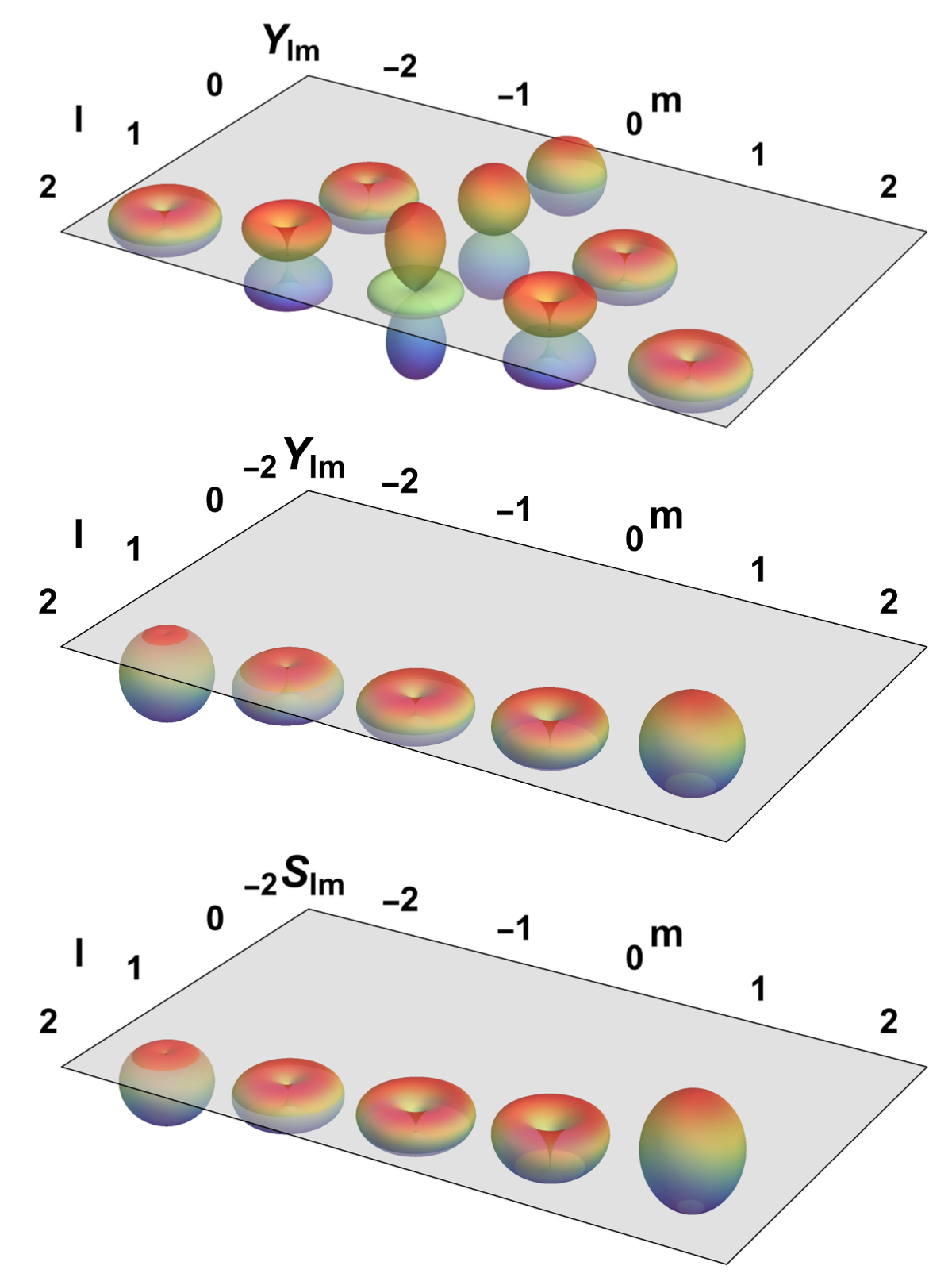
<p>I have often wondered how the various spherical harmonic bases look in GR. In undergraduate classes you typically learn about the scalar spherical harmonics $Y_{\ell m}(\phi,\theta)$. The gravitational waves are typically described with the spin weighted spherical harmonics $Y_{\ell m}^{-2}(\phi,\theta)$. For example the complex time domain strain is</p>

\[h = h_+ - i h_\times = \sum_{\ell m} Y_{\ell m}^{-2}(\phi,\theta) h_{\ell m}\]

<p>Finally, the spin-weighted spheroidal harmonics are the functions which are the eigenfunctions of the angular sector of the Teukolsky equation. These explicitly depend on $\omega$.</p>

\[S_{\ell m}^{-2}(\phi,\theta,\omega)\]

<p>I find both the spin-weighted spherical/spheroidal harmonics buy using the black hole perturbation theory toolkit’s package SpinWeightedSpheroidalHarmonics.</p>

<p>Below, I make an image which shows how each of them look. I did this for spherocity parameter $\gamma = \omega \chi \sim 0.7$. You can see that the spheroidal harmonics have preferential radiation in the upward direction comparing $m=-2$ vs $m=2$. This is because the retrograde mode is weaker, and has a different QNM frequency than the prograde one (slower frequency and similar damping rate).</p>

<p><img src="/assets/images/spherical-harmonics-GR.png" alt="Alt text" class="align-center responsive" /></p>]]></content><author><name>Brian C. Seymour</name></author><summary type="html"><![CDATA[A quick visual tour of spin-weighted spherical and spheroidal harmonics in GR, using the BHPT toolkit.]]></summary></entry><entry><title type="html">LIGO SURF talk about tests of general relativity with LIGO</title><link href="https://www.briancseymour.com/testing-gr-ligoseminar/" rel="alternate" type="text/html" title="LIGO SURF talk about tests of general relativity with LIGO" /><published>2024-07-12T00:00:00+00:00</published><updated>2024-07-12T00:00:00+00:00</updated><id>https://www.briancseymour.com/testing-gr-ligoseminar</id><content type="html" xml:base="https://www.briancseymour.com/testing-gr-ligoseminar/"><![CDATA[<p>Introductory talk to undergraduates in the LIGO SURF program about how GW can test GR.</p>

<p>You can <a href="/assets/documents/Presentations/24-07-12-testing-gr-ligoseminar.pdf">view the slides here</a> directly.</p>]]></content><author><name>Brian C. Seymour</name></author><summary type="html"><![CDATA[Introductory talk to undergraduates in the LIGO SURF program about how GW can test GR.]]></summary></entry><entry><title type="html">Automated Natural Unit Conversions in Mathematica</title><link href="https://www.briancseymour.com/Natural-Units/" rel="alternate" type="text/html" title="Automated Natural Unit Conversions in Mathematica" /><published>2019-06-17T00:00:00+00:00</published><updated>2019-06-17T00:00:00+00:00</updated><id>https://www.briancseymour.com/Natural-Units</id><content type="html" xml:base="https://www.briancseymour.com/Natural-Units/"><![CDATA[<h3 id="introduction-and-review">Introduction and Review</h3>

<p>Natural units are a way to simplify repetitive fundamental constants in theoretical physics equations. In my research, I used three particular unit systems: geometric ($c=G=1$), natural ($c=\hbar=1$), and Planck units ($c=\hbar=G=1$). However, for me it is time consuming to convert to and from natural units. I decided that I would write an extension to Mathematica’s units package to remedy this.</p>

<p>A great summary of natural units goes in more detail in an excellent document <a href="https://www.seas.upenn.edu/~amyers/NaturalUnits.pdf">here</a>. Given a SI quantity $Q_{\text{SI}}$, the quantity in natural units is given by $Q_{\text{geometric}} = Q_{\text{SI}}/A$ for some factor $A$. For the rest of this post, I will use geometric units. Suppose that the quantity has SI units of the form</p>

\[[Q_{\text{SI}}] = M^\alpha \times L^\beta \times T^\gamma \, ,\]

<p>then, one can find $Q_{\text{geometric}}$ with the following factor</p>

\[A = G^{-\alpha} c^{2\alpha-\gamma} \, .\]

<p>So all we need to do to convert between the units is to find $A$.</p>

<h3 id="mathmatica-implementation">Mathmatica Implementation</h3>

<p>The first thing that we need to do is write a helper function that will return the $\alpha$, $\beta$, and $\gamma$ from our previous equation. All I need to do was write a wrapper class for the UnitDimensions[] fuction that Mathematica has.</p>

<figure class="highlight"><pre><code class="language-mathematica" data-lang="mathematica"><span class="nv">GetUnitVal</span><span class="p">[</span><span class="nv">qu</span><span class="o">_,</span><span class="w"> </span><span class="nv">unit</span><span class="o">_</span><span class="p">]</span><span class="w"> </span><span class="o">:=</span><span class="w"> </span><span class="bp">Module</span><span class="p">[{</span><span class="nv">result</span><span class="o">,</span><span class="w"> </span><span class="nv">dims</span><span class="p">}</span><span class="o">,</span><span class="w">
  </span><span class="nv">dims</span><span class="w"> </span><span class="o">=</span><span class="w"> </span><span class="nb">UnitDimensions</span><span class="p">[</span><span class="nv">qu</span><span class="p">]</span><span class="o">;</span><span class="w">
  </span><span class="nb">If</span><span class="p">[</span><span class="nb">Position</span><span class="p">[</span><span class="nv">dims</span><span class="o">,</span><span class="w"> </span><span class="nv">unit</span><span class="p">]</span><span class="w"> </span><span class="o">==</span><span class="w"> </span><span class="p">{}</span><span class="o">,</span><span class="w"> </span><span class="nv">result</span><span class="w"> </span><span class="o">=</span><span class="w"> </span><span class="m">0</span><span class="o">,</span><span class="w">
    </span><span class="nv">result</span><span class="w"> </span><span class="o">=</span><span class="w"> </span><span class="nv">dims</span><span class="p">[[</span><span class="nb">Position</span><span class="p">[</span><span class="nv">dims</span><span class="o">,</span><span class="w"> </span><span class="nv">unit</span><span class="p">][[</span><span class="m">1</span><span class="o">,</span><span class="w"> </span><span class="m">1</span><span class="p">]]</span><span class="o">,</span><span class="w"> </span><span class="m">2</span><span class="p">]]]</span><span class="o">;</span><span class="w">
  </span><span class="nv">result</span><span class="w">
</span><span class="p">]</span></code></pre></figure>

<p>Next, I wrote a function to calculate the constant $A$.</p>

<figure class="highlight"><pre><code class="language-mathematica" data-lang="mathematica"><span class="nv">SItoGeometricDivideFactor</span><span class="p">[</span><span class="nv">qu</span><span class="o">_</span><span class="p">]</span><span class="w"> </span><span class="o">:=</span><span class="w"> </span><span class="bp">Module</span><span class="p">[{</span><span class="nv">\[Alpha]</span><span class="o">,</span><span class="w"> </span><span class="nv">\[Beta]</span><span class="o">,</span><span class="w"> </span><span class="nv">\[Gamma]</span><span class="p">}</span><span class="o">,</span><span class="w">
  </span><span class="nv">\[Alpha]</span><span class="w"> </span><span class="o">=</span><span class="w"> </span><span class="nv">GetUnitVal</span><span class="p">[</span><span class="nv">qu</span><span class="o">,</span><span class="w"> </span><span class="s">"MassUnit"</span><span class="p">]</span><span class="o">;</span><span class="w"> </span><span class="nv">\[Beta]</span><span class="w"> </span><span class="o">=</span><span class="w">
   </span><span class="nv">GetUnitVal</span><span class="p">[</span><span class="nv">qu</span><span class="o">,</span><span class="w"> </span><span class="s">"LengthUnit"</span><span class="p">]</span><span class="o">;</span><span class="w"> </span><span class="nv">\[Gamma]</span><span class="w"> </span><span class="o">=</span><span class="w"> </span><span class="nv">GetUnitVal</span><span class="p">[</span><span class="nv">qu</span><span class="o">,</span><span class="w"> </span><span class="s">"TimeUnit"</span><span class="p">]</span><span class="o">;</span><span class="w">
   </span><span class="nb">Quantity</span><span class="p">[</span><span class="m">1</span><span class="o">,</span><span class="w"> </span><span class="s">"GravitationalConstant"</span><span class="p">]</span><span class="o">^-</span><span class="nv">\[Alpha]</span><span class="o">*</span><span class="w">
   </span><span class="nb">Quantity</span><span class="p">[</span><span class="m">1</span><span class="o">,</span><span class="w"> </span><span class="s">"SpeedOfLight"</span><span class="p">]</span><span class="o">^</span><span class="p">(</span><span class="m">2</span><span class="w"> </span><span class="nv">\[Alpha]</span><span class="w"> </span><span class="o">-</span><span class="w"> </span><span class="nv">\[Gamma]</span><span class="p">)</span><span class="w">
</span><span class="p">]</span></code></pre></figure>

<p>Finally, I used a function that will find $Q_{\text{geometric}}$ by dividing $Q_{\text{SI}}$ by $A$. Afterwards, it converts the result into meters to the $n$ power as is used in geometric units.</p>

<figure class="highlight"><pre><code class="language-mathematica" data-lang="mathematica"><span class="nv">SItoGeometricUnits</span><span class="p">[</span><span class="nv">qu</span><span class="o">_</span><span class="p">]</span><span class="w"> </span><span class="o">:=</span><span class="w"> </span><span class="bp">Module</span><span class="p">[{</span><span class="nv">factor</span><span class="o">,</span><span class="w"> </span><span class="nv">geoqu</span><span class="p">}</span><span class="o">,</span><span class="w">
  </span><span class="nv">factor</span><span class="w"> </span><span class="o">=</span><span class="w"> </span><span class="nv">SItoGeometricDivideFactor</span><span class="p">[</span><span class="nv">qu</span><span class="p">]</span><span class="o">;</span><span class="w"> </span><span class="nv">geoqu</span><span class="w"> </span><span class="o">=</span><span class="w"> </span><span class="nv">qu</span><span class="o">/</span><span class="nv">factor</span><span class="o">;</span><span class="w">
   </span><span class="nb">UnitConvert</span><span class="p">[</span><span class="nv">geoqu</span><span class="o">,</span><span class="w"> </span><span class="p">(</span><span class="s">"Meters"</span><span class="p">)</span><span class="o">^</span><span class="nv">GetUnitVal</span><span class="p">[</span><span class="nv">geoqu</span><span class="o">,</span><span class="w"> </span><span class="s">"LengthUnit"</span><span class="p">]]</span><span class="w">
</span><span class="p">]</span></code></pre></figure>

<p>The full version of these functions which includes geometric, natural, and Planck units is <a href="https://github.com/BrianCSeymour/natural-units-mathematica-conversion">publicly available</a> on my Github. Feel free to use it and I hope that it will save you time in your research!</p>]]></content><author><name>Brian C. Seymour</name></author><summary type="html"><![CDATA[A simple Mathematica extension to automate conversions between SI and natural units like geometric, natural, and Planck systems.]]></summary></entry><entry><title type="html">Sigma Pi Sigma Presentation</title><link href="https://www.briancseymour.com/Sigma-Pi-Sigma-Presentation/" rel="alternate" type="text/html" title="Sigma Pi Sigma Presentation" /><published>2018-11-09T00:00:00+00:00</published><updated>2018-11-09T00:00:00+00:00</updated><id>https://www.briancseymour.com/Sigma-Pi-Sigma-Presentation</id><content type="html" xml:base="https://www.briancseymour.com/Sigma-Pi-Sigma-Presentation/"><![CDATA[<p>I gave a presentation to a conference organized at Sigma Pi Sigma at University of Virginia.</p>

<p>You can <a href="/assets/documents/Presentations/11-9-18-SigmaPiSigma.pdf">view the slides here</a> directly.</p>]]></content><author><name>Brian C. Seymour</name></author><summary type="html"><![CDATA[I gave a presentation to a conference organized at Sigma Pi Sigma at University of Virginia.]]></summary></entry><entry><title type="html">Gravity Group Presentation</title><link href="https://www.briancseymour.com/Gravity-Group-Meeting/" rel="alternate" type="text/html" title="Gravity Group Presentation" /><published>2018-11-01T00:00:00+00:00</published><updated>2018-11-01T00:00:00+00:00</updated><id>https://www.briancseymour.com/Gravity-Group-Meeting</id><content type="html" xml:base="https://www.briancseymour.com/Gravity-Group-Meeting/"><![CDATA[<p>I gave an hour long presentation to the gravity research group at University of Virginia. It specializes on content from my upcoming paper.</p>

<p>You can <a href="/assets/documents/Presentations/11-1-18-Gravity-Group-Presentation.pdf">view the slides here</a> directly.</p>]]></content><author><name>Brian C. Seymour</name></author><summary type="html"><![CDATA[I gave an hour long presentation to the gravity research group at University of Virginia. It specializes on content from my upcoming paper.]]></summary></entry><entry><title type="html">Society of Physics Students Research Introduction</title><link href="https://www.briancseymour.com/SPS-Presentation/" rel="alternate" type="text/html" title="Society of Physics Students Research Introduction" /><published>2018-10-19T00:00:00+00:00</published><updated>2018-10-19T00:00:00+00:00</updated><id>https://www.briancseymour.com/SPS-Presentation</id><content type="html" xml:base="https://www.briancseymour.com/SPS-Presentation/"><![CDATA[<p>I gave a five minute presentation to Society of Physics Students about my research. This was to encourage first year students to get involved in research.</p>

<p>You can <a href="/assets/documents/Presentations/SPS/SPS-Research-Presentation.pdf">view the slides here</a> directly.</p>]]></content><author><name>Brian C. Seymour</name></author><summary type="html"><![CDATA[I gave a five minute presentation to Society of Physics Students about my research. This was to encourage first year students to get involved in research.]]></summary></entry><entry><title type="html">College Science Scholar Presentation</title><link href="https://www.briancseymour.com/CSS-Poster/" rel="alternate" type="text/html" title="College Science Scholar Presentation" /><published>2018-10-17T00:00:00+00:00</published><updated>2018-10-17T00:00:00+00:00</updated><id>https://www.briancseymour.com/CSS-Poster</id><content type="html" xml:base="https://www.briancseymour.com/CSS-Poster/"><![CDATA[<p>I had the pleasure of presenting my research to a group of first year students who are interested in scientific research. I gave an introduction to my research with a poster describing black hole-pulsar tests of general relativity. I used the example of a theory of gravity with varying gravitational constant to show the process of bounding the time derivative of G.</p>

<p>You can <a href="/assets/documents/Presentations/CSS/CSS-Poster-BrianSeymour.pdf">view the poster here</a> directly.</p>]]></content><author><name>Brian C. Seymour</name></author><summary type="html"><![CDATA[I had the pleasure of presenting my research to a group of first year students who are interested in scientific research. I gave an introduction to my research with a poster describing black hole-pulsar tests of general relativity. I used the example of a theory of gravity with varying gravitational constant to show the process of bounding the time derivative of G.]]></summary></entry><entry><title type="html">Testing General Relativity with Black Hole-Pulsar Binaries</title><link href="https://www.briancseymour.com/Testing-GR-with-BH-PSR-Binaries/" rel="alternate" type="text/html" title="Testing General Relativity with Black Hole-Pulsar Binaries" /><published>2018-08-01T00:00:00+00:00</published><updated>2018-08-01T00:00:00+00:00</updated><id>https://www.briancseymour.com/Testing-GR-with-BH-PSR-Binaries</id><content type="html" xml:base="https://www.briancseymour.com/Testing-GR-with-BH-PSR-Binaries/"><![CDATA[<p>Here is my upcoming paper describing tests of general relativity using black hole-pulsar binaries if one is found with next generation telescopes.</p>

<p>You can view the paper at <a href="https://arxiv.org/abs/1808.00080">1808.00080</a>.</p>

<p>The abstract is as follows:</p>

<p>Binary pulsars allow us to carry out precision tests of gravity and have placed stringent bounds on a broad class of theories beyond general relativity. Current and future radio telescopes, such as FAST, SKA, and MeerKAT, may find a new astrophysical system, a pulsar orbiting around a black hole, which will provide us a new source for probing gravity. In this paper, we systematically study the prospects of testing general relativity with such black hole-pulsar binaries. We begin by finding a mapping between generic non-Einsteinian parameters in the orbital decay rate and theoretical constants in various modified theories of gravity and then summarize this mapping with a ready-to-use list. Theories we study here include scalar-tensor theories, varying G theories, massive gravity theories, generic screening gravity and quadratic curvature-corrected theories. We next use simulated measurement accuracy of the orbital decay rate for black hole-pulsar binaries with FAST/SKA and derive projected upper bounds on the above generic non-Einsteinian parameters. We find that such bounds from black hole-pulsars can be stronger than those from neutron star-pulsar and neutron star-white dwarf binaries by a few orders of magnitude when the correction enters at negative post-Newtonian orders. By mapping such bounds on generic parameters to those on various modified theories of gravity, we find that one can constrain the amount of time variation in Newton’s constant G to be comparable to or slightly weaker than than the current strongest bound from solar system experiments, though the former bounds are complementary to the latter since they probe different regime of gravity. We also study how well one can probe quadratic gravity from black hole quadrupole moment measurements of black hole-pulsars. We find that bounds on the parity-violating sector of quadratic gravity can be stronger than current bounds by six orders of magnitude. These results suggest that a new discovery of black hole-pulsars in the future will provide powerful ways to probe gravity further.</p>]]></content><author><name>Brian C. Seymour</name></author><summary type="html"><![CDATA[Here is my upcoming paper describing tests of general relativity using black hole-pulsar binaries if one is found with next generation telescopes.]]></summary></entry><entry><title type="html">LIGO SURF Final Report</title><link href="https://www.briancseymour.com/LIGO-Final-Report/" rel="alternate" type="text/html" title="LIGO SURF Final Report" /><published>2017-09-23T00:00:00+00:00</published><updated>2017-09-23T00:00:00+00:00</updated><id>https://www.briancseymour.com/LIGO-Final-Report</id><content type="html" xml:base="https://www.briancseymour.com/LIGO-Final-Report/"><![CDATA[<p>I spent the 2017 summer working with Marie Kasprazack, Arnaud Pele, and Adam Mullavey at LIGO Livingston through the Caltech SURF Program. I examined nonlinear angular noise coupling into differential arm length of the LIGO Livingston detector. This could be summarized in the following way: I modeled the change in optical path length in the interferometer cavity arms due to misalignment of the cavity mirrors. I did this through an geometric analysis of the change in path length of a Fabry-Perot cavity (such as LIGO uses).</p>

<p>You can <a href="/assets/documents/Papers/LIGO-SURF/LIGOSURF_FinalReport_BrianSeymour.pdf">view the final report here</a> directly.</p>

<p>Alternatively, the full directory containing my work that summer can be found <a href="https://dcc.ligo.org/LIGO-T1700343/public">here</a>.</p>]]></content><author><name>Brian C. Seymour</name></author><summary type="html"><![CDATA[I spent the 2017 summer working with Marie Kasprazack, Arnaud Pele, and Adam Mullavey at LIGO Livingston through the Caltech SURF Program. I examined nonlinear angular noise coupling into differential arm length of the LIGO Livingston detector. This could be summarized in the following way: I modeled the change in optical path length in the interferometer cavity arms due to misalignment of the cavity mirrors. I did this through an geometric analysis of the change in path length of a Fabry-Perot cavity (such as LIGO uses).]]></summary></entry><entry><title type="html">LIGO SURF Final Presentation</title><link href="https://www.briancseymour.com/LIGO-Final-Presentation/" rel="alternate" type="text/html" title="LIGO SURF Final Presentation" /><published>2017-08-24T00:00:00+00:00</published><updated>2017-08-24T00:00:00+00:00</updated><id>https://www.briancseymour.com/LIGO-Final-Presentation</id><content type="html" xml:base="https://www.briancseymour.com/LIGO-Final-Presentation/"><![CDATA[<p>I presented the results of my research at LIGO from the summer of 2017 at Caltech for the SURF final presentation.</p>

<p>You can <a href="/assets/documents/Presentations/LIGO-SURF/BrianSeymour_FinalPresentation_LIGO_SURF.pdf">view the final report here</a> directly.</p>

<p>Alternatively, the full directory containing my work that summer can be found <a href="https://dcc.ligo.org/LIGO-T1700343/public">here</a>.</p>]]></content><author><name>Brian C. Seymour</name></author><summary type="html"><![CDATA[I presented the results of my research at LIGO from the summer of 2017 at Caltech for the SURF final presentation.]]></summary></entry></feed>